
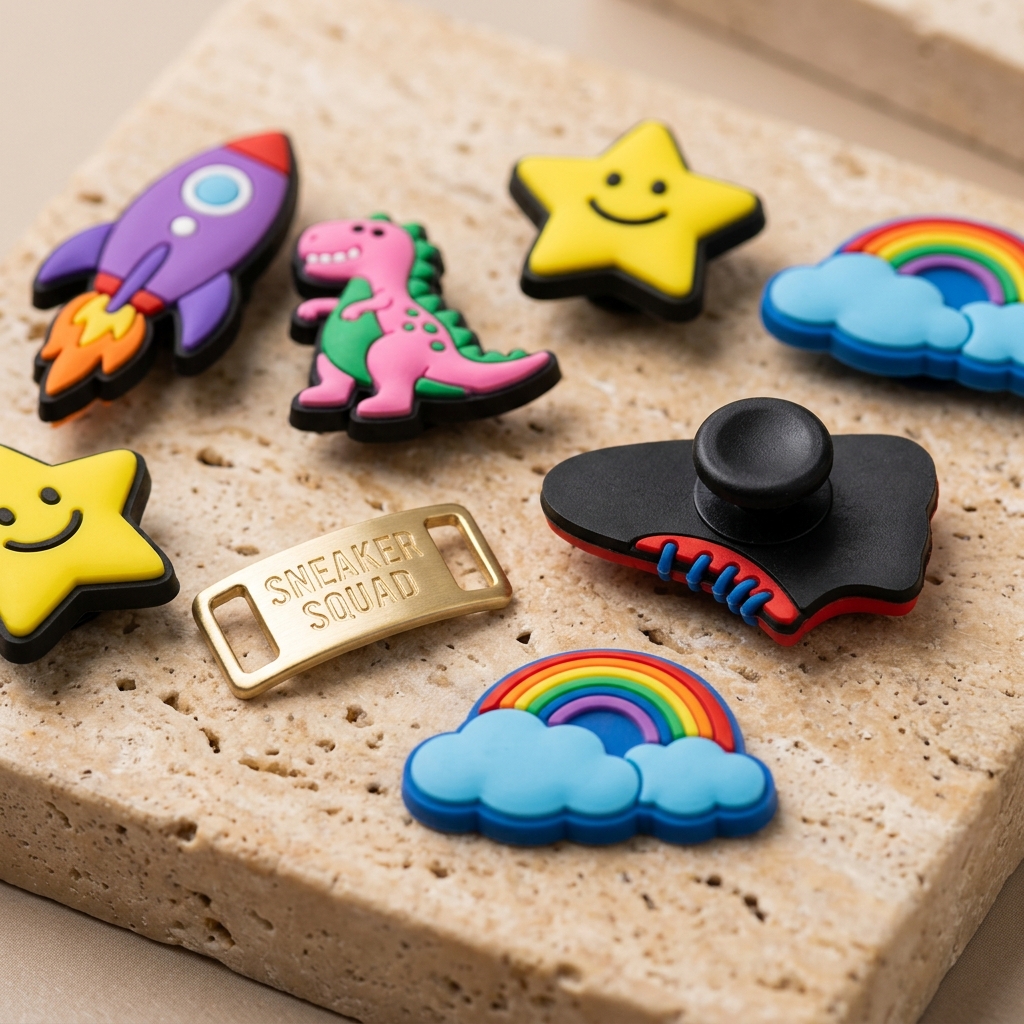
Understand attachment concepts
Footwear charms and decorative attachments may be retained through a molded post or plug, a mechanical interlock, a sewn or laced feature, an adhesive bond, or a combination of methods. “One-piece molded” describes how a component may be formed; it does not by itself prove superior retention, safety or durability. Actual performance depends on the material, geometry, tooling, process controls, footwear opening and the way a wearer handles the item.
A molded attachment can reduce the number of separate parts when the decorative face and retaining feature are formed together. That can simplify assembly and avoid a separate adhesive interface, but it may constrain design geometry and material selection. A bonded ornament can allow different materials, color effects or low-profile constructions, while adding surface preparation, adhesive compatibility, curing and process-control variables. A mechanical two-piece system may be replaceable, but introduces fit and retention interfaces that need validation.
Evaluate the full assembly rather than the loose charm. A supplier’s pull test on a component, a test on a sample upper and a test on a finished shoe answer different questions. Define which one is relevant to the project, who will run it, and what results count as acceptable before samples are approved.
Design around the footwear interface
Start with the footwear opening and material stack. Record the opening shape and dimensions, thickness, stretch, reinforcement, lining and any nearby seams or overlays. A retaining post that fits a rigid molded sole component may not behave the same way in a flexible textile upper. The installation tool and the operator’s access can also affect whether the attachment seats evenly.
Share a controlled drawing of the charm face, rear geometry, thickness, edge radii and any post, flange or locking feature. Identify tolerances and the surfaces that must remain visible. If the opening is created by a separate component, confirm who controls its dimensions and whether the upper changes between sizes. Check removal, replacement and repair expectations: some designs should be removable by a consumer while others are intended to stay attached.
Materials need review as a system. Ask for the proposed polymer or metal family, color method, coatings, adhesive system if used, and any components that may contact skin or be exposed to moisture, sweat, cleaners or outdoor conditions. For bonded designs, the substrate’s surface energy, finish, contamination and texture can change adhesion. For molded designs, wall thickness, gate position, shrinkage, flash, sharp edges and stress concentration may affect fit and appearance.
- Confirm size grading and the opening dimensions across all intended sizes.
- Check interference with laces, eyelets, seams, gaiters and adjacent decorative parts.
- Review exposed edges, pinch points, snagging and comfort during wear.
- Record the installation method, tools, operator steps and inspection points.
Identify likely failure modes
Write down the failure modes before sampling. A charm can detach, rotate, crack, deform, loosen after repeated handling, snag on other materials or damage the upper around its opening. Bonded pieces may lift at an edge, fail cohesively within the adhesive or weaken at a coating or surface layer. Molded retainers may tear, whiten, split or deform if the geometry or material is not suited to the use condition. These are hypotheses to check; they are not claims that every design will fail in these ways.
Look beyond a straight pull. The actual use may apply bending, twisting, peel, impact or repeated manipulation. A test fixture that clamps the wrong place may create a result that does not represent wear. The brand, supplier and laboratory should agree the specimen, loading direction, rate, conditioning, cycle count, sample quantity and pass/fail definition. If a customer specification or market rule applies, cite the exact document and edition.
Consider the consequences of small components and accessible edges. The finished product’s age grading and intended use can affect applicable requirements. Have the product safety or compliance owner identify relevant jurisdiction-specific rules and test evidence; do not treat a trim component’s supplier statement as a finished-product safety determination.
Plan representative validation
Use the intended production materials and attachment process to build representative samples. Include the upper or carrier material, reinforcement, adhesive, backing, opening and assembly method expected in production. A beautifully finished display sample may not represent a production run if it uses different substrates or hand-applied bonding.
Agree a validation matrix with the buyer or laboratory. It may include dimensional fit, installation quality, retention under defined loading, repeated handling, flexing, environmental conditioning and visual inspection. Select tests according to the intended use and risks; a supplier should not invent a universal pass threshold. Record sample IDs, drawing revisions, material lots, process settings, equipment, conditioning, observations and disposition.
Inspect before and after each test. Note displacement, cracks, edge lift, whitening, deformation, upper damage or other agreed signs of failure. If a specimen fails, reproduce the failure, identify whether it comes from geometry, material, process or the footwear interface, then document corrective action and re-test the revised design. Keep the approved sample and report linked to a design revision so changes are visible.
Production control should connect incoming material, tooling revision, assembly settings and final inspection to the approved sample. Any change in material supplier, mold, adhesive, surface treatment or upper opening can affect the result and should trigger a documented change review.
Specify the sample and RFQ
Give the supplier a drawing or dimensioned reference, target footwear style, opening specification, material stack, age grade and destination markets. State whether the ornament is intended to be removable, what side faces outward, how it should be installed and what appearance criteria matter. Identify the required colors, surface finish, logo artwork and intellectual property approvals.
Ask for a concept recommendation with the trade-offs clearly stated: part count, assembly steps, tooling implications, material and finish options, expected fit tolerance and information still needed from the footwear factory. Request sample tooling or production-representative samples as applicable, but do not assume a specific mold lead time, MOQ or test capability until the supplier confirms it for the project.
In the RFQ, separate commercial questions from engineering acceptance. Ask the supplier to quote the selected configuration and separately list the proposed test plan, fixture, specimens, acceptance criteria, report format and responsibility for testing. State that any safety or regulatory evidence must be scoped to the finished product and destination market.
- Charm drawing, dimensions, colors and logo files
- Footwear style, opening geometry, upper material and reinforcement
- Preferred attachment concept and removal expectations
- Target age group, destination markets and safety owner
- Sample quantity, test plan, acceptance criteria and report scope
- Production change-control and approved-sample reference
Buyer questions
Is a one-piece molded charm always stronger than a glued ornament?
No general conclusion is possible from the process name. Compare representative assemblies using an agreed test plan and intended footwear materials.
Can I use one pull-off number for every charm?
Set the criterion for the design and intended use. Test direction, fixture, conditioning and specimen construction affect the result.
Does a component retention test prove a shoe is safe for children?
No. Finished-product assessment depends on the intended market, age grade and applicable requirements. Ask the brand’s product safety owner to define the evidence.
What samples should be tested?
Use samples representing the intended production materials, opening, reinforcement, adhesive or molded attachment, and assembly method.
Need an item-specific review?
Send the product family, drawing or reference, intended application, target market and required evidence. Availability, specifications, samples, pricing and timing are confirmed for the selected project.
Send an RFQ for this guide’s product family →